Petite Messe Solennelle
Rossini's last masterpiece

May 15, 2026 4:56 pm ET
My latest piece for The Wall Street Journal.
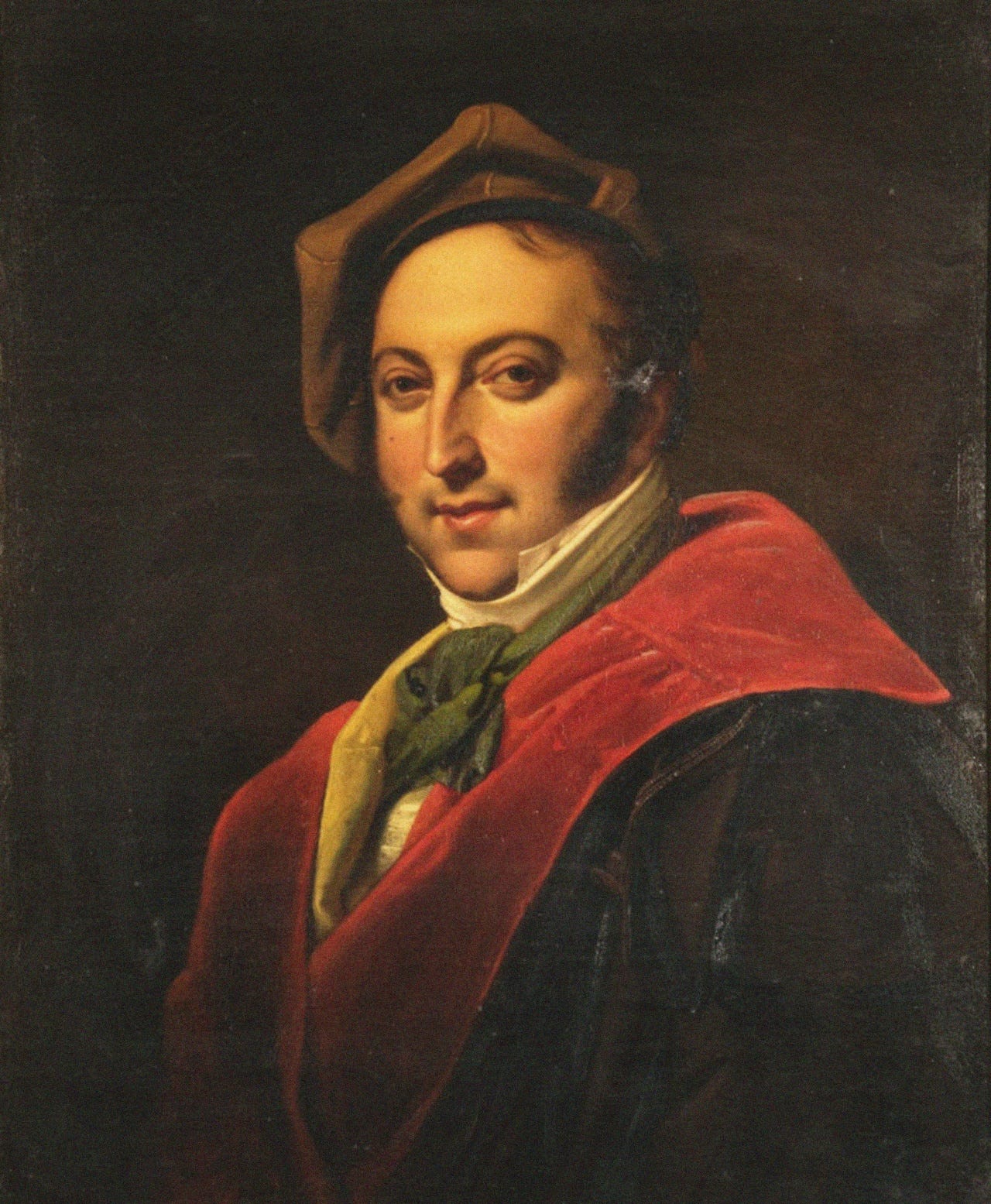
Gioachino Rossini by an anonymous artist. Getty Images
One of the oddest and most affecting pieces in the choral repertory is coming to Cincinnati’s May Festival on Tuesday. Gioachino Rossini called his last major work “Petite Messe Solennelle”—a “Little Solemn Mass”—although it can take upward of 75 minutes to perform and it is as sweet as it is solemn.
Joe Miller will lead the Vocal Arts Ensemble in Cincinnati’s neo-Gothic Christ Church Cathedral and will respect the idiosyncratic forces the composer originally requested—a small chorus of singers with four soloists, two grand pianos and a harmonium, the last of which might be described as a small, foot-pumped keyboard instrument that falls somewhere between an organ and an accordion.
It was Rossini’s first major work in more than 20 years. There have been many explanations for his decision to stop composing opera in 1829, when he was only 37 years old. The romantic legend was that the composer was by then so successful and wealthy that he moved to a Paris townhouse and gave sumptuous parties and musicales for the rest of his life.
Certainly, there was some truth to this—and invitations Chez Rossini were highly prized. But the young master was also a physical and emotional wreck, suffering from acute gonorrhea (in those days treated with mercury, silver nitrate and even arsenic) as well as depression and chronic exhaustion. Moreover, after his final opera, “Guillaume Tell,” the longest and grandest he wrote, he may have felt that he had given his all in the 39 stage works that he had produced in less than 20 years.
Yet he never fell completely silent. After his death, manuscripts for more than 150 piano pieces, songs and chamber works were found among his effects. They were eventually published as “Péchés de vieillesse” (“Sins of Old Age,” Rossini’s own title for some of the notebooks in which they were written), and the best of them are salon music of the highest, strangest order.
But the Petite Messe was something else. It was composed in the summer of 1863 to commemorate the construction of a private chapel on a Paris estate. Attendees at the 1864 premiere there included not only the Parisian elite but the composers Meyerbeer, Auber and Ambroise Thomas; in rehearsal, Rossini himself turned pages for the first pianist and nodded tempo instructions.
On the manuscript’s back page the composer wrote: “Dear God, here it is finished, this poor little mass. . . . I was born for comic opera, as you well know! A little skill, a little heart, that’s all I have. Be merciful then, and admit me to Paradise.”
Rossini’s devotion, undoubtedly sincere, was never permitted to cloud his humor. He might be likened to that friend of Samuel Johnson’s who apologized that he had never quite managed to become a philosopher: “I don’t know how, cheerfulness was always breaking in.” And so Rossini fills this Mass with juicy tunes, startling digressions (a long chromatic meditation for two pianos), and much music that could have come right out of his operas.
The “Domine Deus,” for example, is a genuine virtuoso aria for tenor—it was a favorite of Luciano Pavarotti’s and Enrico Caruso sang it in his final recording session. And the “Laudamus Te,” with its insistent back-and-forth reiteration of the simplest consonant harmonies, sounds like a prefiguration of Virgil Thomson’s “Four Saints in Three Acts.” There are passages for unaccompanied chorus that hark back to church music of the Renaissance and moments that seem like Dada before its time. One moment the music envelops us in a mysterious hush and then it is downright jaunty.
The mixture of two pianos and harmonium creates a timbre that somehow manages to seem both eerie and comfortable, and the silences that surround the sounds are as important as the sounds themselves.
Rossini orchestrated the music in the year before he died. His reasons for such an expansion were simple: The pragmatic composer—always a man of the theater—was aware that orchestration was inevitable and is said to have explained that he was doing it himself so no lesser composer would be able to. Large forces often bring in larger audiences, more revenue, and greater opportunities for musicians to get paid.
He did a more-than-competent job—he was Rossini after all—but the result always reminds me of shining a halogen light into a place of hallowed dim. The chamber version is the “Petite Messe Solennelle” you want. It is one of Rossini’s most precious and individual gifts, something no other composer could have imagined.